We have been hunkered down in chilly, stormy Leipzig this week. We got a few inches of snow midway through and it was actually nice to have it feel like winter and not just a long, gray, dark night. We are a month after the winter solstice and the days are noticeably longer. We still get out for a daily walk and to grab groceries. We also popped into town for some ramen on Thursday and that was tasty.
Since there’s not a lot of news, we are going to answer some questions from my sister (Thanks, Jana!) This is Nathan’s debut at the blog, so that’s news, I guess!
——-
What podcasts are you listening to?
Jill:
So many that I love.
- Cautionary Tales
- Revisionist History
- No Such Thing as a Fish
- Re:Thinking with Adam Grant
- Everything Everywhere Daily
- No Stupid Questions
- Dear Hank and John
- Daughters of Ferrix
- Wait Wait…Don’t Tell Me!
- Hard Fork
- Mike Birbiglia’s Working It Out
- Follow Him
- What’s Your Problem?
- The Happiness Lab
…. I could go on.
It’s kind of ridiculous. It’s a daily practice (habit? addiction?).
Nathan:
- The Gist (Mike Pesca) – a daily news program that keeps me a little connected to goings-on in the US
- No Stupid Questions (conversation between Angela Duckworth and Mike Maughn) – from the Freakonomics network, this is one of my favorites as it is usually a nice blend of interesting and fun on a Sunday morning.
- Easy German – meant for German students, it is a conversation about basic subjects like interesting aspects of the language etc. in Germany.
- Auf Deutsch Gesagt – another German language conversational podcast, the first half is the conversation and the second is a kind of on-the-fly german dictionary where terms from the conversation are defined or explained. It might sound weird but I think it is a great format.
- Everything Everywhere Daily – A daily trivia “snack”, about as deep as you can dive in ten minutes.
- No Such Thing as a Fish – British comedy podcast based on “facts” which are true but often absurd.
- Hard Fork – a conversational podcast about technology to keep me abreast of what is going on, especially now that I am not in the thick of it anymore. The rapport between the hosts is really light and fun (maybe “fun and funny” are a common thread in a lot of the podcasts I like)
There are many other podcasts that I sample or listen to from time to time but I have been listening more to audio books lately to help with studying German.
Have you read any books this past year that you’d recommend?
Jill:
I had to cut back on my reading a bit in 2023 to free up more time for school, so I only finished 76 books. 😀
Non-fiction:
-
- How Will You Measure Your Life? Clayton M. Christensen
-
- And There Was Light Jon Meacham
-
- The Comfort Crisis Michael Easter (reading his newest, Scarcity Brain, right now)
-
- Steal Like an Artist Austen Kleon (re-read)
-
- These Precious Days
- This is the Story of a Happy Marriage
Two essay collections by Ann Patchett
-
- Thinking With Type Ellen Lipton
-
- Misfit Gary Gulman
-
- The Anatomy of Peace The Arbinger Institute
Fiction:
-
- Lessons in Chemistry Bonnie Grams
-
- Tom Lake Ann Patchett (I read several of her novels last year, but this was my favorite. All are good)
-
- Thank You For Listening Julia Whelan
Favorite Fiction Series:
-
- Inspector Gamache Novels; The first one is Still Life Louise Penny
-
- Maisie Dobbs Jacqueline Winspear
-
- Longmire; The first one is Cold Dish Craig Johnson
Nathan:
For audiobooks I use the Libby app. The Salt Lake County library system is one of the best we have seen in our limited exposure to the world and they have a lot of digital content including language learning materials so it is really nice that we can still use it even though we are not in Utah right now. I also have an account here at the Leipzig library and I use Libby with that too, although the selection of German audiobooks is paltry – just two books from David Foster Wallace and then all of the Harry Potter books. Kind of odd, I think.
Regarding books, for non-fiction I would recommend The Scarcity Brain by Michael Easter. It is about how and why we are maladapted to many of the things that are so readily available in modern society including food, entertainment, information and what we might do about it. The ideas are presented as anecdotes and personal experiences of the author (some of which are pretty extreme, like going to Iraq). It is a great follow up to Easter’s earlier book Comfort Crisis which I have recommended to some family members before. For fiction, Jill has me hooked on books by Ann Patchett. Many (or maybe all?) of her books are available as audiobooks. I have been through a few, including a couple of her books that are more like essays on her own life. I think you can’t go wrong with anything by her.
Do you have a new “guilty pleasure” food that you’ve found in Germany?
Jill:
Nothing new, really, but I don’t feel guilty about anything that we eat here…it’s an essential part of making the most of this experience! However, having easy access to some of my favorites is nice. As for food that’s more “German”, I love a grilled Thüringer bratwurst with spicy German mustard. Döner Kebab is everywhere and so yummy–it’s Turkish, but so ubiquitous in Germany, kind of like curry in the UK. Even the cheapest chocolate here is better than the standard product available at home. Same for bread. That is not to say that we don’t eat well or eat similar things at home. It’s just easier to find some of our favorites here.
Nathan:
Guilty pleasures, hmmm, well I don’t really feel guilty about it and it wasn’t such a surprise but I am enjoying the chocolate here and I am of the camp that consider chocolate one of the best pleasures in life. Even the budget chocolates at the store (on sale they are less than $1 per bar) are top quality. I usually don’t prefer the Milka brand (German chocolate) at home when I can get Lindt, but here the price + quality is so good I can’t resist.
What languages are you learning, and are you using a specific app or program?
Jill:
I’m not the language nut that Nathan is, but I have been working on my German. I do Duolingo every day, I’m reading my scriptures in German a few days a week, and I have been using an audiobook from the library. The Google Translate app is really great for everyday life here, especially the Google Lens feature. I have trouble understanding people still, especially when they speak quickly. I do a lot better with reading. I’m mostly hopeless with thinking of the appropriate words to say in the moment, but my pronunciation has improved a bit. I’ve told Nathan that with my American clothing, my long curly hair, and my terrible German, I’m not really very good at blending in here. 😁
Nathan:
One of the main reasons I wanted to come to Leipzig was to learn more German, so that has been a priority. I am not in any formal classes so I am trying to create my own “immersion-lite” program here which includes a smattering of the following:
– Anki for Android flashcard app – I drill flashcard decks of words and sentences/phrases that other people have made and I also have my own deck that I add to daily when I encounter a word or phrase that I want to work on remembering.
– Duolingo – German for English speakers is good which is what I do daily but I also like to do the English for German speakers and a bit of German for Spanish speakers to integrate some of the Spanish neurons in my brain with the German ones.
– Podcasts and audiobooks (trying to maximize “comprehensible input”) as previously mentioned, Salt Lake County has German learning course audiobooks so I use some of those.
– Reading – I started with kids books (our last AirBnB had a shelf of kids books in German, very convenient for me) and these days I am working through some young adult literature now. I also read everywhere I can, newspapers, flyers, signs around town, program notes for music concerts – that is the nice thing about being here in Germany, it is all around us all the time.
– Netflix/AmazonPrime – when we watch shows I like to have the subtitles on if German is an option and sometimes I like to mumble the German words …maybe it is annoying but Jill hasn’t complained yet.
——-
Ok, so that’s the end of Q&A. If you are curious about anything about our experience here in Germany or life on the road (since we have been traveling for a good chunk of each year since 2018), feel free to ask!
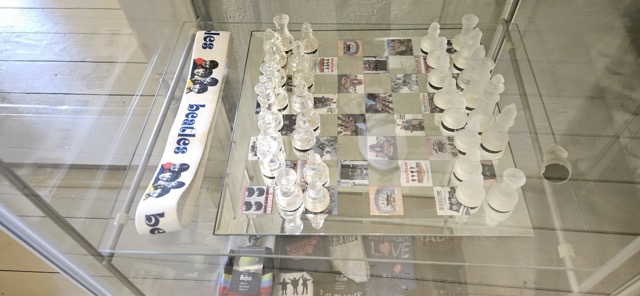
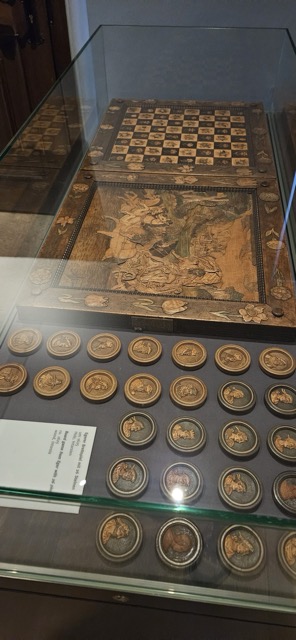
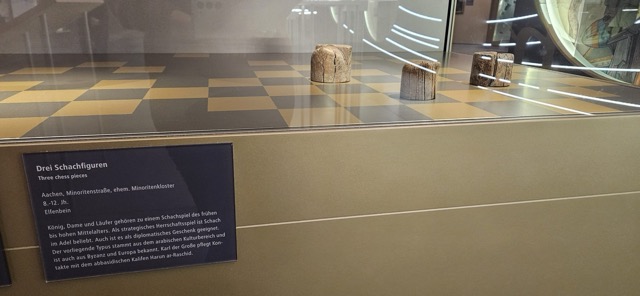
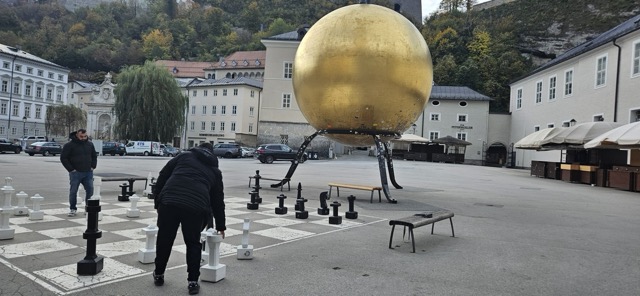
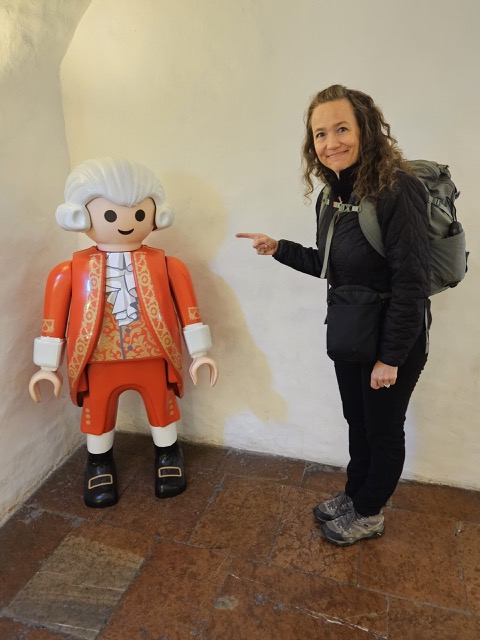
And a note on the photos I have included with this post: we took no photos this week (that’s a first), so I have included some photos of various chess sets that we have seen during our trip, mostly for our three-year-old, chess-loving Teddy. Oh, and one really big Playmobil Mozart. Enjoy!
Here’s the next video of our travels: November 2023.
That was great! Thank you both for answering questions. I’ll have more later. Love you. Have a great week!
Really fun to hear all your answers, Mom and Dad.