
Hi, all! What a week! We did a bit of normal and a whole lotta different. We learned from RadioLab this week that novel experiences make you “live a long life”. Here’s hoping!
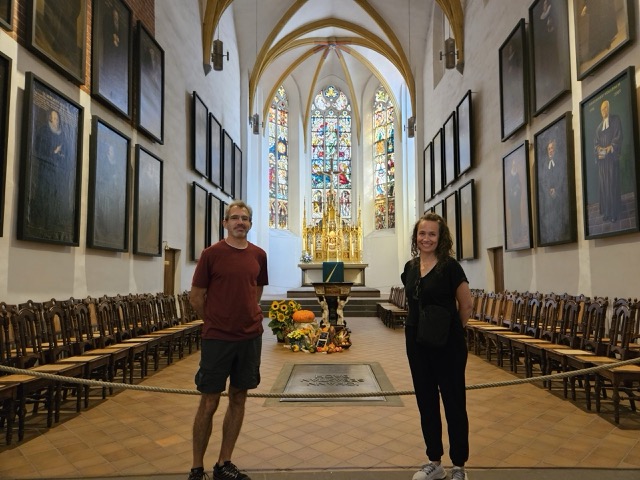
The week started off with a guided tour of Leipzig. “But,” you say, “you’ve already been there for over a month.” Correct, my friend. But a very sweet, if slightly odd, fellow that we met at church offered to give us a special tour of the city, so we just had to take him up on it. We wandered around the city center while he gave us the history of the place. He is obviously enthusiastic about his home and loves to share that. We enjoyed seeing the city through his eyes a bit and we learned a few new things as well.
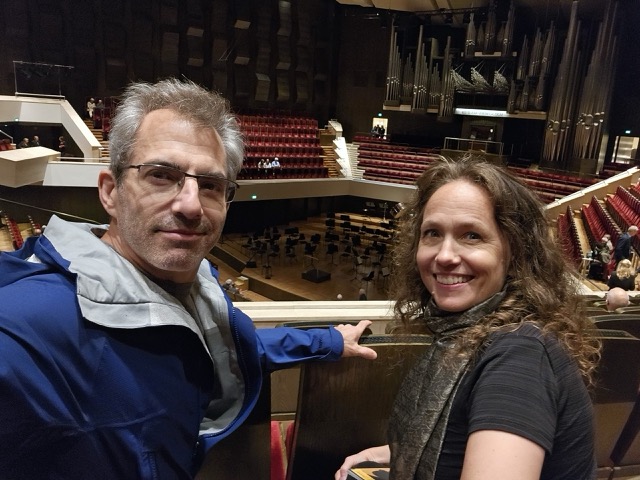
On Tuesday, it was a national holiday here. I think I’ll save the historical details until next week’s post, but here I will mention what the holiday vibe was around here. It was crazy crowded with lots of energy…on Monday…not on Tuesday. On the holiday, it was a snooze-fest. I think they just celebrate quietly by having a day off. Certainly not the loud, bombastic, fireworks-a-palooza that we think of for a national bash. Anyway, we did attend a concert that night in the famous concert hall, the Gewandhaus. It was Beethoven’s 9th Symphony (very German) with a 40-minute prelude of some guy (politician?) talking and talking and talking. At least the music was good!
Wednesday wasn’t anything too crazy. We went to the central library to study. We found on our last visit that they have a large collection of printed music up on the top floor as well as two electronic pianos. So, I worked on school while Nathan practiced away. On our way home, we stopped to check out an Asian market that Nathan found on Google because he wanted to find some kimchi. Now you can choose your own adventure. To hear a ridiculous story about a 4-year-long quest for a certain bottle of sriracha, read the next paragraph. To skip right to the rest of the post, skip the next paragraph.
Once upon a time, we went to Budapest for a whole week in 2019 because we could rent an Airbnb for $25 per night and we thought, “Why not?” Then, we kinda fell in love with the place. Hungarian food is awesome, the people are so nice, there is beautiful architecture and history, the language is absolutely bonkers, and they have fun live music. But also, THE MOST AWESOME HAMBURGERS! So anyway, we went to this one burger joint in an old building where we sat in a window (not by a window, IN the window) on the second story and ate a mind-blowing meal. At said burger joint, as expected, they had various condiments on the table, one of them being a bottle of sriracha. “So what?” you reply, “Sriracha is not that strange.” But how about black pepper sriracha? Huh? It was delicious and we thought, “we should get some of that.” So, every time we went grocery shopping, we were looking for it. We knew the brand (Flying Goose) and we kept finding the regular sriracha, but never the black pepper. We searched all of Europe (well, the parts we went to) for the next 3 months and never found the stuff. I googled it when I got home at the end of the summer and found out that they do indeed ship the stuff, but not to the U.S. Foiled again! I dreamed up elaborate schemes around shipping a bottle to some acquaintance in Europe and then having them send it on to us, but never had the guts to actually do something so dumb. Every once in a while, I’d search again with no luck. Until Tuesday. We rode the escalator down into an Asian market in the basement of a shopping center in Leipzig. Nathan asked, “do you want anything besides kimchi?” And at that moment I looked over to a shelf with sriracha bottles and I thought, “I wonder if….” AND THERE IT WAS!!!! Anyway, after searching for it for 4 years, did it live up to our memories of it in Budapest? Of course not! Was it a tasty addition to our (kinda boring) seasonings at home? Definitely. 😀 It’s an extra spicy barbeque sauce with soy sauce added in.
And now back to the market…We bought microwavable ramen (except we don’t have a microwave) and these crazy crunchy peas that taste like spicy Trix cereal. It was a fun diversion.
During all of this stuff, Nathan was wrestling with the red tape of getting us registered at our new address and hopefully getting us residence permits so we can stay longer. (No one else will appreciate this reference, but it’s here for my sister: “There’s enormous red tape in the bush.”–another dumb movie reference…see “The In-Laws”.) He got the required document, he made copies, he did his research, he collected our passports and trekked to the office to start the process, and…came right back home because there were 200 other people there doing the same thing. So, he’s going to change his strategy and try again tomorrow. Pray for us.
So after our less-than-pleasant experience with the weekend crowds on some previous excursions (see Dresden and Hamburg) or travel tactics has been to leave Leipzig on Friday morning and return before Sunday afternoon. So, this week, we headed southwest to Eisenach, Erfurt, and Weimar. Never heard of them? I hadn’t really either, but all three cities turned out to be pretty cool. For one thing, we got to see something we’ve been missing at bit: hills!
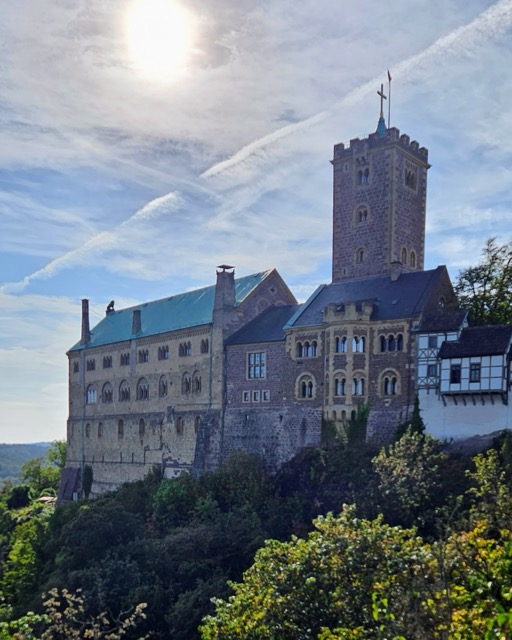
Eisenach is the birthplace of Bach (yes, him again). Since we already had a pretty good experience with the Bach museum here in Leipzig, we felt like out time was better spent seeking out the other super-famous resident, Martin Luther. After he nailed his 95 theses to the door of the church in Wittenberg, he retreated to Wartburg Castle in Eisenach under the protection of Frederick III. (Just an aside here: I was always under the impression that tacking his points onto the church door was an extra bit of rebellion. Not so. The door of the church was basically a town’s bulletin board.) While cloistered at Wartburg Castle, he translated the New Testament into German (more dangerous behavior), thereby making it available to the common people and standardizing the German language. I’m no Lutheran, but I do appreciate his efforts. Here’s a thought from Luther for you: “You can’t keep the birds of worries and cares from flying over your head, but you can keep them from nesting in your hair.”
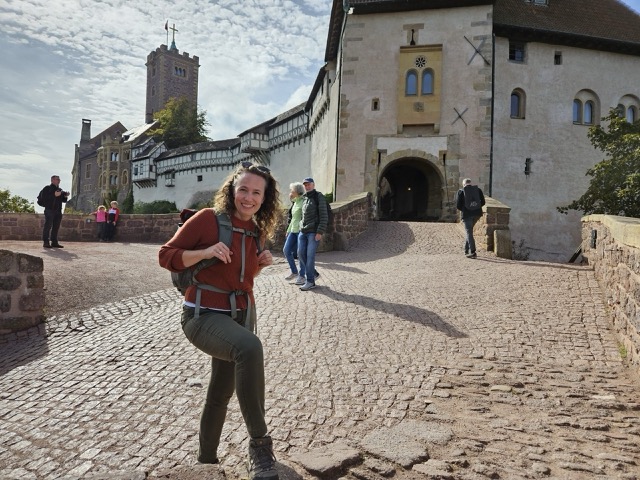
The castle was pretty great. I know I said that we don’t do every castle, but this one was worth it. It has a thousand-year history of construction and reconstruction. There are amazing mosaics from the 19th century in a medieval style. It’s perched on a rock over some gorgeous countryside. We hiked up to the castle and enjoyed a very good tour in English by a (very) German tour guide, which was fun all on its own. We also had a great conversation with another guide about William Tyndale–he also did his Bible translation in Germany! So cool. But he did not have the good luck of Martin Luther and died for his efforts.
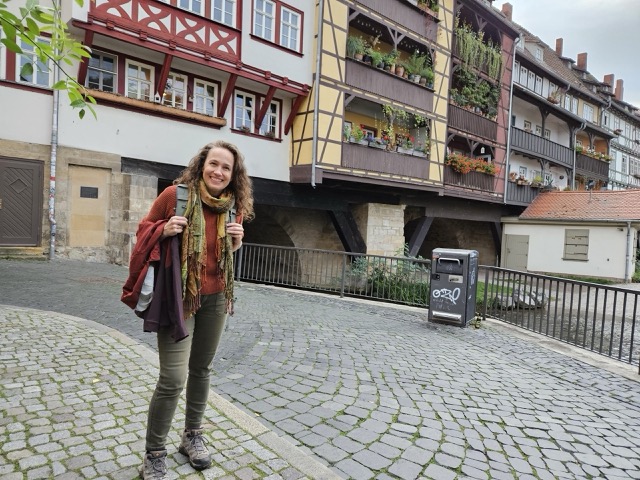
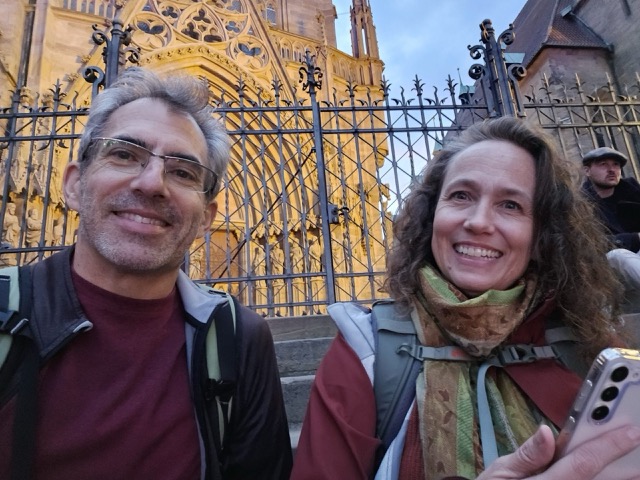
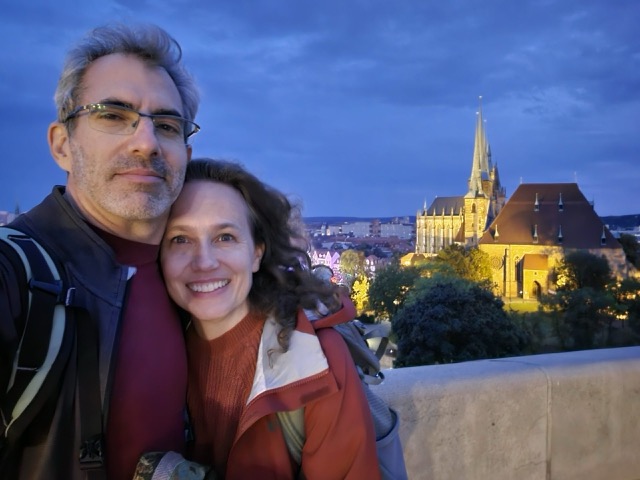
After Eisenach, we stopped in at Erfurt. Here is another Luther town, where he became a monk. It was also a trade town, making its fortune on woad dye. The town is really charming and still has a medieval vibe without feeling like a cartoon or a tourist trap. It’s still a living place with plenty of regular, working Germans. We spent some time wandering around, ate some crazy bar-b-q, and watched the sunset over the twin churches from the walls of the citadel. Then we hopped on the train for a quick ride to Weimar. We found our little accommodation and hit the hay.
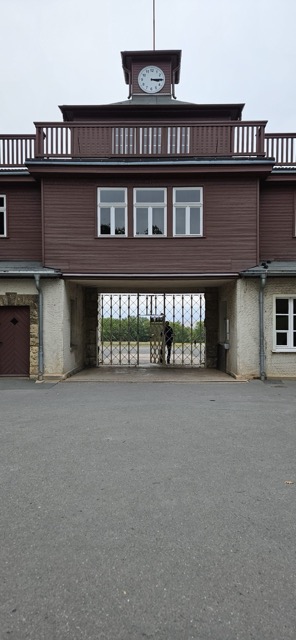
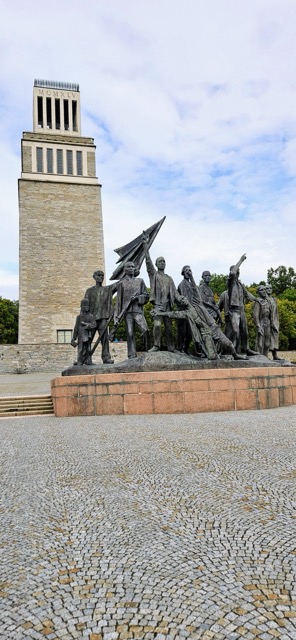
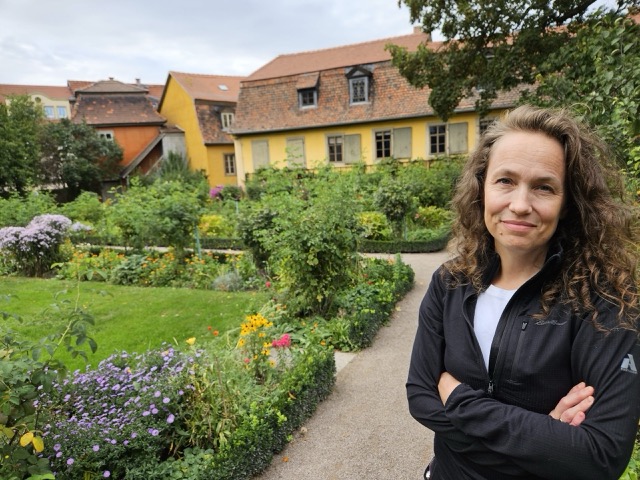
Weimar is the birthplace of “German Classicism” and was the home of Goethe, Schiller, Liszt, and the Bauhaus movement. Unfortunately, all that intellectual and artistic glory can’t counteract the fact that it is also home to the former Buchenwald concentration camp. We visited the site of the camp and the memorial there on Saturday morning. It was sobering, of course. Saturday was a gray, cool, and windy day. The camp is up on a hillside, overlooking the surrounding woods and valley. It felt like another layer of torture to me: being able to see the beautiful countryside and being trapped behind barbed wire.
According to Wikipedia, “[Buchenwald] was one of the first and the largest of the concentration camps within Germany’s 1937 borders. Many actual or suspected communists were among the first internees.” It’s estimated that 280,000 prisoners passed through the gates and 56,545 of them died there. The purpose of the camp changed over time, starting out with Germans who needed to be “retrained” and then transitioning more to Jewish prisoners, other “enemies of the state, and POWs when the war started. Prisoners were forced to work, manufacturing arms and other things for the war effort. The conditions were especially horrific for the Jewish and Romani prisoners.
“In early April 1945, as US forces approached, the Germans began to evacuate some 28,000 prisoners from the Buchenwald main camp and an additional several thousand prisoners from the subcamps of Buchenwald. About a third of these prisoners died from exhaustion en route or shortly after arrival, or were shot by the SS. The underground resistance organization in Buchenwald, whose members held key administrative posts in the camp, saved many lives. They obstructed Nazi orders and delayed the evacuation. On April 11, 1945, in expectation of liberation, prisoners took control of the camp. Later that afternoon, US forces entered Buchenwald. Soldiers from the 6th Armored Division, part of the Third Army, found more than 21,000 people in the camp.” (U.S. Holocaust Memorial Museum) Then, the Soviets used the camp for five more years to imprison their own prisoners (another 28,000, some 7,000 of which died).
The thought we had over and over was not just, “This is horrific.” It was more like, “This is horrific and how many other people are in terrible circumstances now that we don’t know about?” There are an estimated 50 million people in the world TODAY living in some form of slavery and 1.2 million forcibly displaced or stateless refugees RIGHT NOW. I think that we hear the stories of the holocaust and we are shocked and dismayed and we think, “What a waste. I’m glad that is behind us.” But it’s not. I don’t know how to solve the problem, but I do know that we can all reach out to someone who is different from us, to someone who comes from somewhere else or from a different background. Learn their story, and then they will be a person to you instead of just “other”. That’s a start. Sermon over.
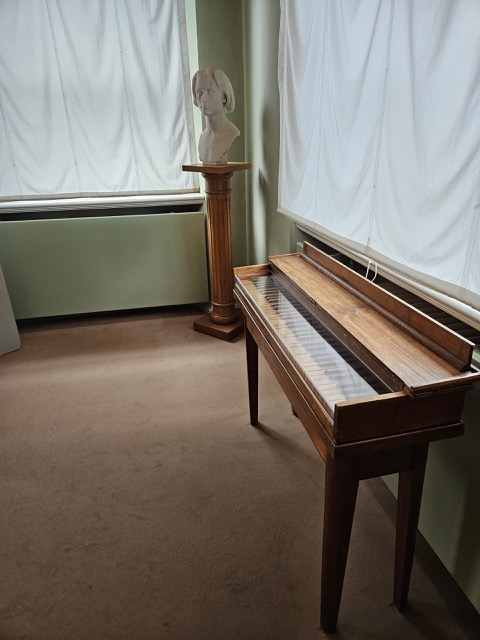
We then visited the house where Liszt lived until his death (but he didn’t die there) and the house where Goethe lived until his death (he did die there). Then we lucked into a free concert of choral and orchestral students from the Franz Liszt Institute in the city church (Stadtkirche Sankt Peter und Paul). They performed 3 cool choral works and Psalm 42 by Felix Mendelssohn-Bartholdy. The entire concert was conducted by students and the music sounded so good in that space that the pieces were meant for.
We left in the dark and rain the next morning to catch an early train back to Leipzig and beat the crowds. We walked at least 4.5 miles on Friday and 9 on Saturday, so we are glad to be back for a bit of a rest. But we’ll be back at it again soon.
One last thing (if you’ve made it this far). I have deliberately not gone on and on about all the yummy food we’ve been sampling, since that’s not everyone’s jam. But if you would be interested in an “extra” about the nibbles, comment below and I will see what I can do! Tchüss!

Yes. Food!
Yes, for the food