Short version:
We visited Genova (Genoa) in Liguria, Lucca and Siena in Tuscany, then Orvieto and Civita di Bagnoregio on our way to Rome. We were in Rome for three days, then it was on to Assisi, Ravenna, Parma, and Cremona before returning to Torino. We had a blast, but we were very ready to return “home”, do some laundry, and regroup.
Long version:
Day 1 – Torino to Genova
The trip started with a drive from Torino to Genova. We have been a bit surprised at the highway tolls here in Italy—we definitely make the choice between saving time by taking the expressway and saving money by taking the local roads. Many days, we have plenty of time so we take the slower route. Nathan is a rock star in the driver’s seat—navigating tiny, medieval streets, winding mountain roads, and itty bitty parking places with style.
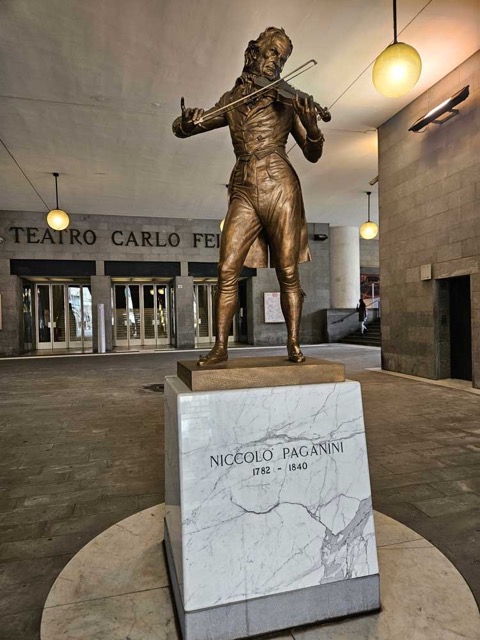
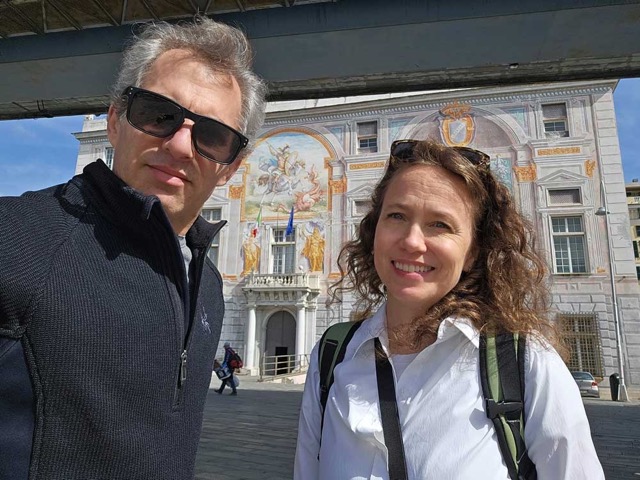
We were in Genova to chase another composer/musician: Niccolò Paganini. He was born in Genova in 1782. His most famous violin, The Cannone, is there at the municipal museum. It was made by Giuseppe Guarneri del Gesù. We walked around the city museum and also visited the “Red Palace” museum on Via Garibaldi.
We are constantly reminded that these countries that we all think of as quintessentially European are really very modern creations. The cities, however, are very old, each one seems to have had it’s “golden age”, and the residents are very proud of that history. Genova was, of course, a great naval power, so we decided to also visit the maritime museum. We learned about the Genovese domination of shipping over seven centuries and about another famous guy, Christopher Columbus. Love him or hate him, he did have a world-changing impact. (A note just for Hanna…do you know about the SS Andrea Doria?)
One of the most pleasant parts of our visit to Genoa was just wandering the streets, walking up and down the hills. We earned our snacks of gelato and focaccia with pesto!
Day 2 – Genova to Lucca to Siena
The next day we were bound for Tuscany to stay in Siena. However, we heard that the city of Lucca, with it’s medieval walls still in tact, was worth a stop. “Wait,” you say, “Why didn’t you stop in Florence…Pisa…the Cinque Terre? Those places are so famous and so great!” Well, my friends, it is because we have already visited those places. We brought the kids to Italy for three weeks in 2006. Since we were much younger, much more ambitious, and maybe a bit more crazy, we tromped all over with our munchkins, hitting all the big names and places. As with many “bucket list” places, we are so happy we visited, but we don’t feel like we need to repeat.
So, to Lucca we headed. So many of these towns have city centers with “No Drive Zones”, so we parked outside of town and walked under the gate into the city, like so many for centuries before us. The walls really are cool—huge and imposing from the outside, wide enough for plenty of strolling and bike riding on top. It’s the birthplace of Puccini, but he wasn’t really on our “chasing composers” tour. We spent a couple of hours exploring on a self-guided walking tour and then it was time to drive to Siena.
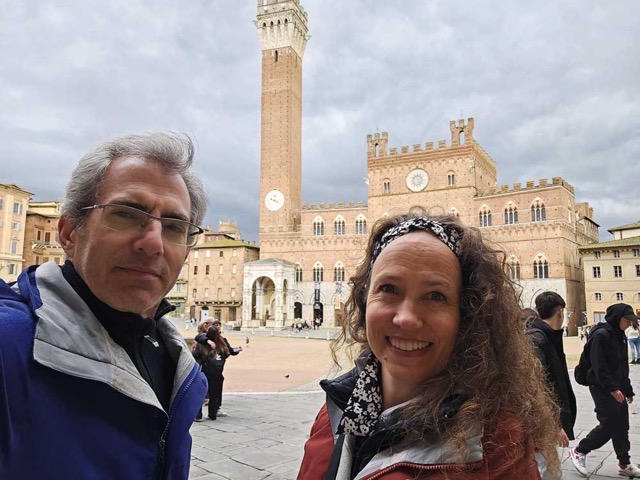
We really enjoyed our time in this Tuscan hill town. The main piazza is so unique. It’s a big semi-circle and it slopes down toward the city hall. Siena was also a powerhouse in it’s day and one of it’s claims to fame is that it was an very secular and fiercely independent republic. The fact that the main square is dominated by the municipal buildings and not the cathedral is very telling. One thing that Siena is famous for now is the “Palio”—a horse race with no rules around this very square with the different neighborhoods cheering on their horse and jockey. It’s crazy to think about after seeing where the race takes place.
The Sienan people have a strong civic pride and they love to show it off. They borrowed the she-wolf from Rome and display her everywhere, including in one of the floor mosaics and at the entrance to the cathedral. While most other churches tout their relics of saints, in Siena they proudly display two giant flag poles that symbolize a historic win over Florence. The cathedral is beautiful, from the striking striped marble exterior, to the sculptures by Donatello and Michelangelo, to the Piccolomini Library.
After taking our walking tour, we found a great little restaurant for dinner and ate pasta and lots of olive oil. We stayed at a hotel in a restored abbey—great location, terrible pillows.
Day 3 – Siena to Orvieto to Civita di Bagnoregio to Rome
It was time to leave Tuscany and move on to Umbria and Lazio. This was a day that we really enjoyed the “slow travel” mindset, at least for the first half of the day. Driving through the countryside was a delight as we took in the olive groves, cypress trees, and the purple-blue hills. We were ultimately bound for Rome, but we made two stops.
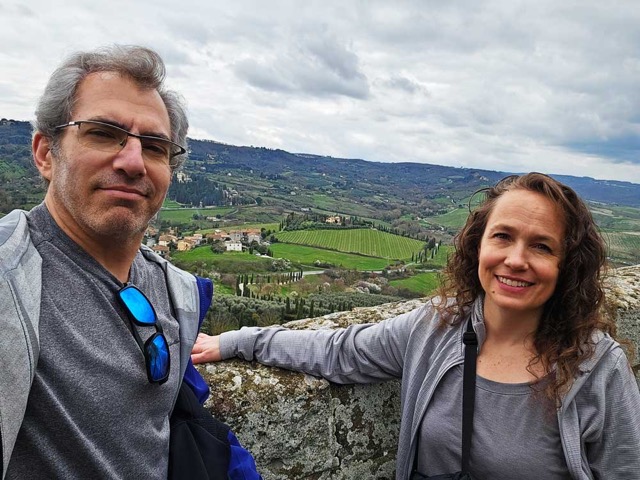
First, we went to the hill town of Orvieto. We enjoyed the sights of this ancient city, from another striped cathedral to the famous ceramics on display in the shops. However, I though the best part was the hike into town and the views from the walls.
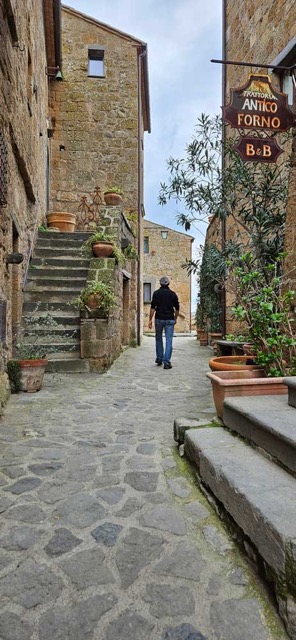
Next, we zipped over to Bagnoregio so that we could visit it’s neighbor, Civita, which is now a “dead town”, as all of it’s full time residents have left. I guess having the cliffs that support the town crumble to the valley floor make a place less desirable for inhabitation, but it makes for a fun place to visit. The town is perched on a tufa “tuffet” in the middle of a valley and you reach it by crossing a foot bridge. There are shops and restaurants in the tiny town, but they are just there for the day-trippers. Some of the buildings are just facades, as the back side of the building has slipped into the valley below.
Last, we payed the toll and zipped to Rome. After negotiating the packed streets, we were feeling a bit pampered as we pulled into our private, gated parking spot at our AirBnB. Our hosts there took good care of us—we were their very first guests in a new studio apartment. We walked across town, catching a few sights along the way. I forget how dense the history and monuments are in Rome. We all know the biggies, but really there is art, archeology, and layered history EVERYWHERE in Rome. We visited a jazz club for sushi and a jazz duo (guitar and double bass), and then trudged back to our little apartment and a well-earned night of rest.
Day 4 – Rome
Since we began the trip with only half of it planned, we took a morning to sleep in and then plan some more. Then we headed out to do some walking tours. However, there was a bit of a wrench in the works as it was the Rome marathon and we kept encountering crowds and closed streets. But it was fun to cheer on the runners and then find opportunities to zip across the course to continue our tours.
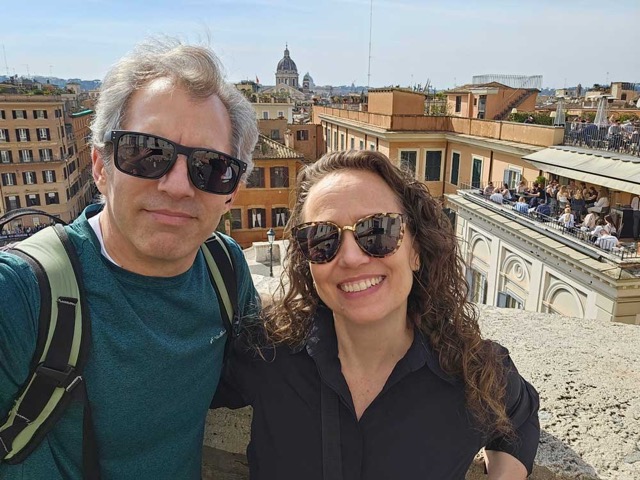
As we did all the major stuff when we were in Rome with the kids, we decided to just do a lot of walking, visit the outdoor sights, and see some of the neighborhoods that would be new to us. The Pantheon is still impressive from the outside and lots of things, like the Spanish Steps and the fountains are outside anyway!
It was a truly gorgeous day, and we enjoyed walking Trastevere and seeing the Jewish Ghetto. Since we weren’t doing the big stuff, it was a good opportunity to see some of the lesser known sights, like the Basilica of Saint Cecilia in Trastevere. And (bonus), they aren’t crowded and are often free!
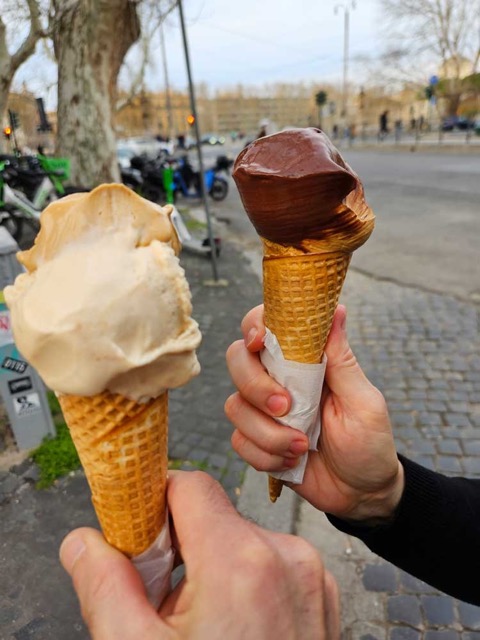
I know this may be an unpopular opinion, but I get tired of Italian food. There is plenty of it, if you want pizza or pasta. But it’s often sub-par and sometimes you just want something different, you know? So we had tacos! They were ok, but we really miss authentic Mexican food. We did have some truly delicious gelato as we strolled across the bridges over the Tiber.
Day 5 – Rome
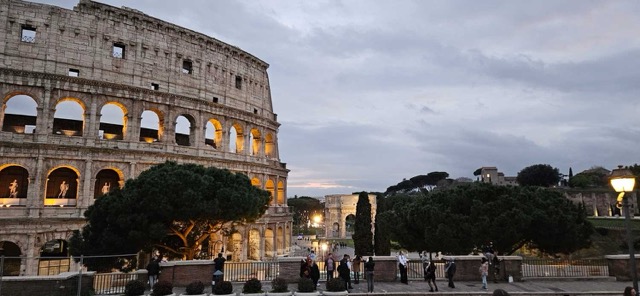
We continued with our “just walk around and see the stuff” strategy the next day. We headed to the Vatican and, after seeing the line for security at St. Peter’s Cathedral (it circled the entire piazza), we were pretty happy with that plan. The scale and scope of that place is crazy. We strolled around the Castel Sant’Angelo, and then we decided that Rome was a good opportunity to see a movie in English. So we ducked into a theater to see “Dune II” and give our feet a break. We finished off the evening with some tasty Roman-style pizza (crispy crust) and a walk around the Colosseum.
Day 6 – Rome to Assisi
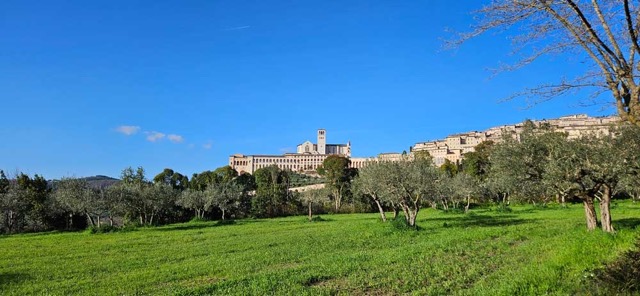
It was time to see something new, so we drove away from Rome and back to Umbria. I think that maybe Tuscany gets too much attention…Umbria is just as beautiful! We parked outside the walls of the pilgrim city of Assisi and walked to our hotel there. The town is famous for it’s favorite son, Francis, of course, but there is a lot more to it than that. It’s also the origin of the corresponding order for women, the Poor Clares, founded by St. Chiara. There were many impressive ideas to contemplate, even if you aren’t a believer in the spiritual side of their messages: living simply, embracing and caring for nature, and the customary greeting “pax et bonum” or “peace and all good.”
The town is so lovely and well-cared for. The upper town is stunningly set up on the hill with the Cathedral of St. Francis and all of it’s arches on one end. The lower town is nice, too, with another basilica that’s so big, it has another church inside of it! We ambled up and down the lanes and then down into the lower town and back up the hill. We ate a nice meal and turned in for the night.
Day 7 – Assisi to Ravenna
We continued on the next day to another town that was “the center of it all” for at least a while, Ravenna. Any art history student can tell you what the main attraction in this town is…
Mosaics!
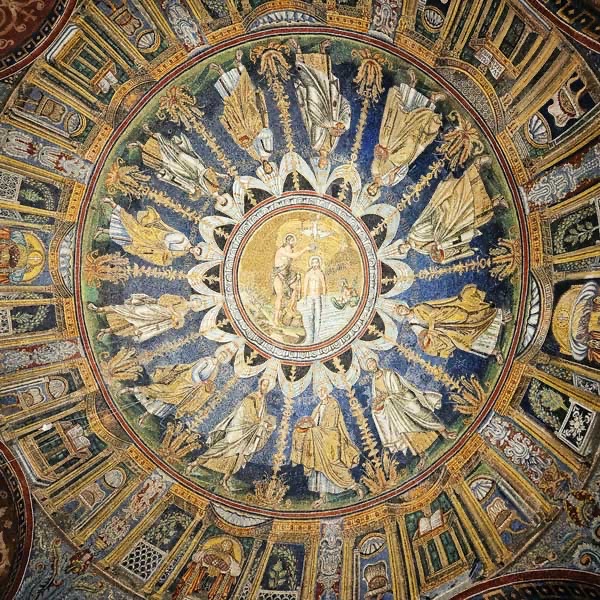
They did not disappoint. They are spread over eight sights and we visited five of them. The colors are striking and they are remarkably preserved, for are done 1500 year ago. The delicate features of the figures are amazing and the various geometric motifs are so fun. It was well-worth jostling with the host of school field trips to get a glimpse.
Ravenna is also where Dante Aligheri is buried. His tomb is in a supposedly “sacred, silent” area…but some neighborhood kids were blasting techno as loud as possible in the adjoining piazza. Weird. I personally can’t say that Ravenna was a charming town, as there isn’t really much of a pedestrian city-center and the bicyclists dominate, but it was definitely worth the visit.
Day 8 – Ravenna to Parma
We were getting a bit tired at this point, but we knew we needed to stop in Emilia-Romagna. We originally thought we would spend some time in Bologna, but some sort of event or convention was happening in the city, so hotel prices were through the roof. Instead, we decided to head right to Parma and we booked a food tour, since the region is famous for (and super proud of) its culinary delights.
The drive through the farmland was nice. It seemed like everybody had a vineyard and two or three different types of orchard. The cherries and plums were in full bloom, dotting the fields with pink. We did a swing on the outskirts of Bologna, driving up the hill to the sanctuary of Madonna di San Luca. There is a covered arcade all the way up the mountain to the church with 666 arches.
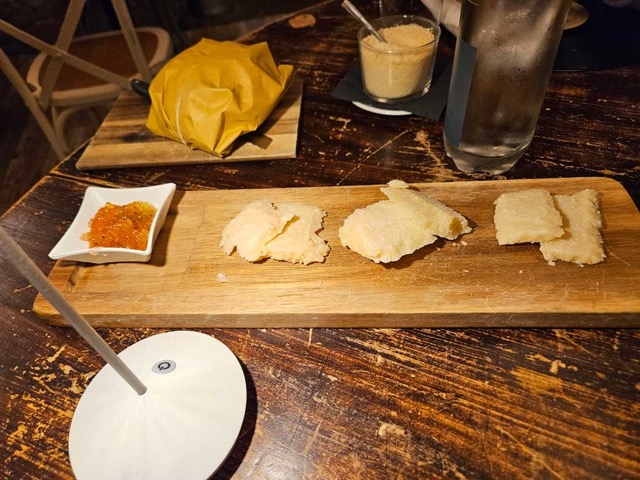
We spent some time exploring on our own and we stopped for lunch. Then we checked into our room for the night and met our tour guide, Michelle. She was very passionate about Parma, its history, and its food and she talked pretty much non-stop for three and a half hours. But she added to our appreciation for Parmigiano-Reggiano and Prosciutto di Parma. We tasted pricey balsamic vinegar from Modena and ate tortelli d’erbetta (a stuffed pasta in butter) and anolini (another stuffed pasta, in broth or in ragu sauce). Nathan ordered the most amazing pistachio gelato. The Parmense are crazy proud of their gastronomic heritage. The cathedral is also stunning, especially the Coreggio frescoes in the dome.
We also had to visit the tomb of Niccolò Paganini. It was rumored that Paganini had sold his soul to the devil in exchange for his musical talent. That nonsense, coupled with a miscommunication about last rites before he died, meant that the Catholic Church denied him burial in his hometown on Genova. It ended up that he was buried in Parma. We walked across the Po river to the cemetery to visit the beautiful monument there.
Day 9 – Parma to Cremona to Torino
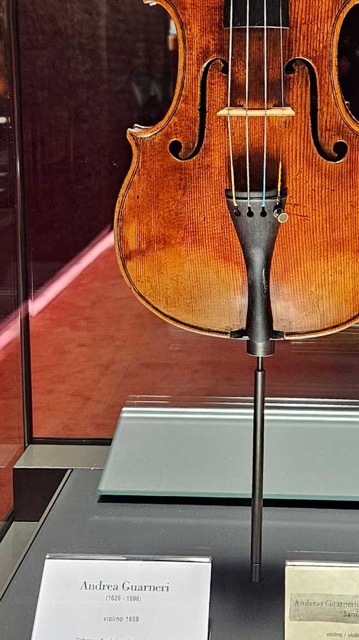
We were ready to return to normal for a few days, but we had one more stop to make. We went to Cremona to visit the Museo del Violino, dedicated to the many maestros of stringed instruments (Amani, Rugeri, Guarneri, and Stradivari) and the home to some of the surviving instruments.
The museum was nice and we enjoyed our visit to the “treasure chest” with the most famous instruments. It also houses a very fine auditorium—beautiful designed and acoustically lovely. We attended a short concert in which a violinist played the “Vesuvio” Strad.
All good things must come to an end, so we hopped on the expressway and zipped back to Torino to do laundry, eat something besides cheese and ham, and plan our next adventure. We will go north later this week to see family in Switzerland! Ciao for now!
p.s. I don’t think I mentioned that we found out that Alex and Hanna are expecting another boy! We are so excited!
Not Warm. Loving It Anyway.
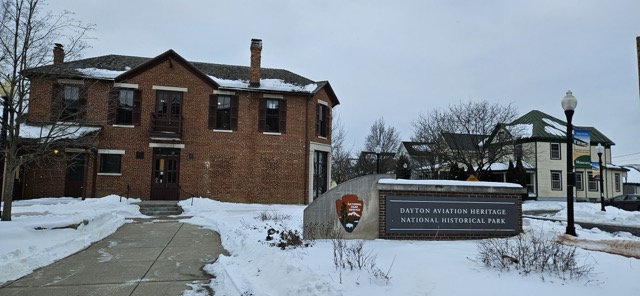
Hello from chilly Ohio! We had a great week traveling northward toward one set of grandkids, despite Nathan coming down with a cold. We had some fun in Nashville, where we had a pleasant surprise, and in Dayton, where we finally visited a museum we've been trying to...
Goodbye to Warmth
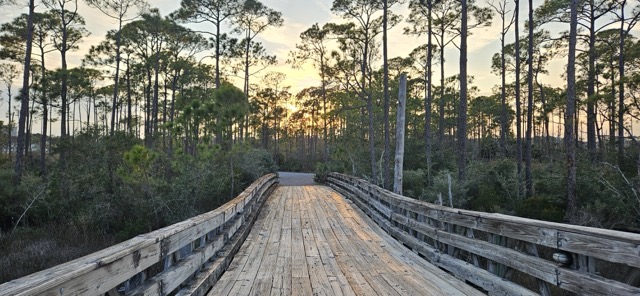
We've had a great, if quiet, week here in Florida. We've managed to book some fun future travel plans, talk to the kids and grandkids and other family, and enjoy this corner of the world. This slice of Florida has been great this month. We've really enjoyed being able...
Just Chillin’
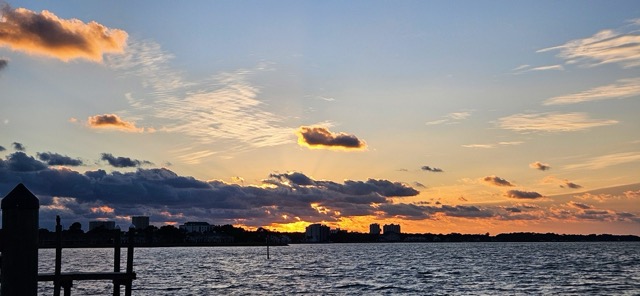
We're still here in Florida, working on projects and getting in our daily walks and recommended daily doses of sunsets and healthy food. We don't do much that's exciting from day to day. Nathan reads, studies languages, and practices the piano. I've made some crafts,...
Crazy to think that was just one week. Thanks for writing it up.
The secret to driving and parking here: get the smallest car that will do the job and make sure it is loaded with all the cameras and sensors to help you squeeze into the parking spaces! 😉
The little Renault Captur we are driving ain’t too shabby. If we get within a foot of anything, even when paying tolls, alarms start going off…
You did so much! Amazing! Loved reading about it. Congrats to your new grandson on the way. xoxo
Thanks, Emily! Love you! ❤️